


Five conversations that changed the way one couple thought about retirement—and reminded me that the best retirement plans evolve as assumptions are questioned.
A few years ago, if someone wanted to know how much money they would need for retirement, they would probably meet a financial planner. Today, things have changed. Retirement calculators are everywhere, and online tools can prepare a fairly detailed retirement estimate in a matter of seconds. Personally, I think that’s a welcome change. If these tools encourage people to start thinking about retirement earlier than they otherwise would have, they’ve already done something valuable. Read More: Retirement Planning Calculator
A few months ago, Abhijeet and Sonali walked into my office with three different retirement numbers. Abhijeet had tried a couple of retirement calculators, Sonali had asked an AI tool, and a close friend had confidently suggested yet another number.
Abhijeet spread the papers across the table and smiled.
“Looks like I can retire with three different amounts. I was hoping you could tell me which one is correct.”
I glanced through the papers before pushing them gently to one side.
“We’ll certainly come back to these,” I said. “But before we discuss the numbers, I’d like to understand the people behind them.”
They looked at each other, slightly puzzled. So I asked them a question that no calculator had asked.
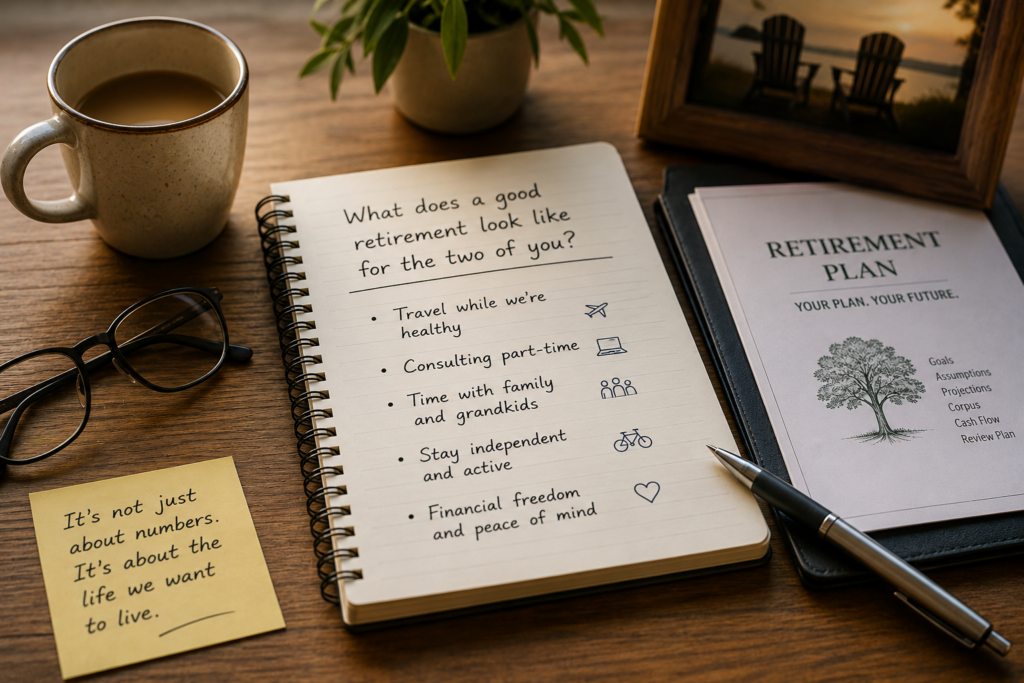
“What does a good retirement look like for the two of you?”
Abhijeet answered almost immediately. “Honestly, I’ve never thought about it that way. I just want to make sure we don’t run out of money.”
Sonali smiled. “I’ve thought about it many times.”
For the next few minutes, we hardly spoke about investments. Instead, we spoke about life after work. Sonali wanted to travel while they were still healthy enough to enjoy it. Abhijeet wasn’t sure he wanted to stop working completely. He imagined taking up consulting assignments for a few years because he simply couldn’t picture himself sitting at home. Read More: How will your Post Retirement Life look like?
As they got up to leave, Abhijeet glanced at the retirement calculator printouts still lying untouched on my table. “Aren’t we going to use those?”
“Of course we are,” I replied. “But before we calculate the retirement you need, let’s first understand the retirement you want.”
That was where the real planning began.
Why have you assumed only 11%?
When Abhijeet and Sonali returned the following week, the retirement plan was ready. I began by taking them through the broad picture. We revisited the retirement they had described in our first meeting and looked at how their current savings, future investments and expected expenses came together in the plan. A few minutes in, Abhijeet pointed to one of the assumptions in the report.
“You’ve assumed an annual return of around 11%. Equity has delivered better returns over the long term. Why shouldn’t we use that instead?”
“We have to begin with a return assumption,” I replied. “Without it, there is no way to prepare a retirement plan. But remember, a retirement planning assumption is only a starting point. It isn’t a promise the market has made to us.”
He nodded, though I could tell he wasn’t entirely convinced. So I picked up a blank sheet of paper and drew two simple timelines.
“Let’s imagine two people retire with the same corpus. Both withdraw the same monthly income, and both eventually earn the same average return over the next twenty years.”
“So both should be fine.”
Instead of answering, I marked a sharp market fall in the first few years on one timeline and the same fall much later on the other.
Abhijeet looked at the sketch for a few moments. “The first person keeps withdrawing money when the market is down. By the time it recovers, a part of the portfolio has already been sold.”
He had answered his own question. We never came back to the average return.
Instead, we discussed how to structure their retirement investments so that the money needed during the initial years wasn’t entirely dependent on what the markets happened to do. The return assumption in the report remained almost the same, but the discussion had shifted from chasing a higher return to building a retirement plan that could survive difficult years.
As I turned the page, Sonali paused. “I have a question too. You’ve used 6% inflation throughout the plan. How did you arrive at that number?”
“It’s a reasonable starting point,” I replied. “Just like the return assumption we discussed earlier. Without it, we can’t estimate what your future expenses might look like.” Read More: Reasonability: The Missing Link in Financial Planning
She nodded before asking, “But will it remain the right retirement planning assumption for the next twenty or thirty years?”
Instead of answering directly, I asked them a different question. “Do you think your household expenses have increased exactly in line with the inflation numbers you hear every year?”
Both of them smiled.
“I don’t think we’ve ever looked at it that way,” Abhijeet admitted.
“That’s because inflation is not just about prices going up,” I said. “It’s also about life changing.”
I shared a simple example from my own life. There was a time when I hardly spent anything on fitness. Long working hours, irregular meals and the occasional burger didn’t seem like much of a problem. Today, my monthly budget looks very different. A gym membership has become a necessity, a trainer keeps me disciplined, healthier food choices cost a little more, and whey protein and other supplements have quietly found a permanent place in my monthly expenses.
My spending has certainly increased, but not only because prices have gone up. It has increased because my priorities have changed. And honestly, I’m happy to spend that money today if it helps me avoid much larger medical bills tomorrow.
I see the same pattern in almost every family. A young couple experiences inflation differently from a couple supporting ageing parents. Someone receiving a pension looks at rising expenses differently from someone drawing a monthly income from accumulated savings. Even two neighbours in the same apartment building can experience very different inflation.
That’s why I encourage clients to look beyond the inflation number printed in the newspaper and start tracking their own spending. Go back five or ten years. Which expenses have grown the most? Which new expenses didn’t even exist earlier? Healthcare, travel, domestic help, hobbies or supporting family members often become a much bigger part of the budget than we imagine. Those answers usually tell us far more than any headline inflation number. Read More: Why is Retirement considered to be the Most Important Goal?
By now, Sonali wasn’t looking at the report anymore. She was thinking.
“Come to think of it,” she said, “our life itself has changed quite a bit over the last ten years.”
“Exactly,” I replied. “That’s why we’ll keep coming back to it. As your life changes, we’ll ask whether 6% still reflects your reality.”
Abhijeet quietly turned the next page. “I always assumed we’d spend less after retirement,” he said. “Your plan doesn’t seem to think so.”
I smiled. “Let’s talk about that.”
I always thought we’d spend less after retirement.
As we moved to the next page, Abhijeet looked for a few moments before saying,
“One thing surprised me.”
“I always thought our expenses would come down after retirement. But in your projections, they don’t really reduce. Why?”
Abhijeet pointed to another assumption about retirement planning. Isn’t that how it usually works? No office commute, no work-related expenses, children become independent… shouldn’t life become less expensive?”
“It sounds logical,” I replied. “In fact, that’s exactly what most retirement calculators do. They take your current expenses, remove a few work-related costs, and project the rest into the future.” I paused before adding, “The problem is that retirement doesn’t simply reduce expenses. More often, it changes them.”
For someone retiring from a salaried job, the first few years are often very different from what they had imagined. After decades of working, they suddenly receive a sizeable retirement corpus through EPF, gratuity, leave encashment, superannuation benefits, and their own savings. For the first time, a substantial amount is sitting in the bank account, and quite naturally, a few long-postponed dreams begin finding their place. Read More: Allocate with Purpose – Investment strategies for Education and Retirement
The house finally gets renovated. The long-awaited holiday is no longer postponed. An old car gets replaced. Some help a child with higher education or buying a house. None of these decisions are wrong. In fact, they are often the very reasons people worked and saved for so many years.
The challenge is that these expenses rarely appear in retirement calculators because they are not monthly. They are life events. And if we don’t discuss them while preparing the retirement plan, they can quietly leave a much bigger dent in the retirement corpus than we had anticipated.
A few years later, life usually settles into a more predictable rhythm. The large one-time expenses are behind you, and the monthly budget becomes easier to manage. Just when it feels as though everything has stabilised, another transition quietly begins.
Healthcare starts occupying a larger share of the household budget. Regular health check-ups become more frequent. Medicines become a monthly expense. Sometimes the house needs small changes to make everyday living easier. At other times, you may need a caregiver or additional support. The spending hasn’t suddenly increased overnight, but what you spend on has changed.
Sonali listened quietly before saying, “So retirement expenses don’t really go down.”
“They usually don’t,” I replied. “What changes is the shape of those expenses.” Then I added, “In fact, retirement itself is changing.”
Years ago, many families postponed travel, hobbies and experiences until retirement. Today, more people choose not to wait. They would rather travel while health and energy are still on their side. As a result, some expenses that once belonged to retirement have quietly shifted into the years before it. That doesn’t make retirement cheaper. It simply changes the pattern of spending once again.
That’s why I’ve stopped believing in one retirement expense number for the next thirty years. Retirement has different phases, and each phase is spent differently. A good retirement plan recognises those phases instead of assuming that life after sixty will look the same from the first year to the last. Read More: Income or Expenses – What matters more for your Financial wellbeing?
We’ve planned the money. But will I actually be able to spend it?
As we were about to wrap up, Abhijeet closed the report but didn’t get up. It felt as though there was still something on his mind.
“There is one thing I still can’t figure out,” he said after a brief pause. “We’ve spent the last two hours discussing how much I can safely spend after retirement. The numbers make sense. The plan makes sense. But I’m not sure I’ll ever be comfortable seeing my savings go down.”
I smiled because in many ways this was the most important question of the afternoon.
For almost thirty-five years, Abhijeet had done exactly what most disciplined investors do. He earned, saved, invested, and watched his retirement corpus slowly grow. Every salary increment meant a higher SIP. Every bonus was another opportunity to invest. Progress was measured by one thing—the portfolio becoming bigger than it was the previous year.
Retirement quietly changes that equation. For the first time in your financial life, the portfolio is expected to do what it was always meant to do—support your life. Instead of adding to it every month, you begin drawing from it. Instead of celebrating a growing corpus, you slowly learn to become comfortable watching it reduce over time.
The maths is straightforward. The emotions rarely are.
Some people struggle to spend even when they can comfortably afford to. Years of disciplined saving make every withdrawal feel uncomfortable. Others go to the opposite extreme. The excitement of finally having time, freedom, and a sizeable retirement corpus encourages them to spend much more than they had originally planned.
Money habits don’t disappear on the day we retire. They are built over decades. Someone who has always been thoughtful about spending is unlikely to become extravagant overnight. Equally, someone who has enjoyed a certain lifestyle rarely becomes extremely frugal simply because their salary has stopped.
That’s why some of the most important conversations in retirement planning happen outside the spreadsheet. The numbers tell us what is possible. The conversations help us understand what is comfortable.
Sonali looked at Abhijeet and smiled. “I knew this would be your biggest concern.”
He laughed. “You’re probably right.”
So… we’re done now, right?
The meeting had gone on much longer than any of us had expected. We had discussed investment returns, inflation, changing expenses, and even something as personal as whether Abhijeet would feel comfortable spending the retirement corpus he had spent a lifetime building. The report was now full of notes, circles, and a few assumptions that had already changed during our discussion.
As we stood up to leave, Abhijeet smiled. “So… we’re done now, right?”
“I hope not,” I replied.
Both of them looked at me, slightly surprised.
“When we prepared this plan, we made several assumptions. We assumed a reasonable investment return. We estimated inflation. We tried to understand how your expenses may evolve and, more importantly, the kind of retirement you wanted to create. Every one of those assumptions reflects your life as it is today. But life doesn’t stay where it is.”
A promotion may increase your savings. A child may decide to settle abroad. You may choose to work longer because you enjoy it, or retire earlier because your priorities have changed. Markets will go through cycles. Tax laws will change. Health may demand a different lifestyle.
None of these changes means the retirement plan has failed. They simply mean the plan needs to evolve along with your life.
I often compare it to using a GPS. Before the journey begins, it suggests the best route based on what it knows at that moment. But if a road is closed, traffic builds up or you decide to take a different turn, it doesn’t insist on the original path. It quietly recalculates and helps you reach the same destination.
A retirement plan should work the same way. The destination may remain unchanged—a financially secure and peaceful retirement—but the route will almost certainly need a few adjustments along the way. Read More: 20 Hidden Risks to Your Retirement Plan
Abhijeet nodded. “So this report isn’t really the end of the process.”
“No,” I replied. “It’s the beginning of a conversation.”
As Abhijeet and Sonali walked out of the office, they carried the same retirement plan they had come to collect. The document hadn’t changed very much. Their understanding of retirement had.
Retirement Planning Assumptions Need Regular Review
A few years ago, most people came to a financial planner for help with calculations. Today, calculators are everywhere. AI can estimate a retirement corpus in seconds, compare different scenarios and answer questions that once required a long meeting. I genuinely believe that’s a positive change. The easier it becomes for people to start planning, the better.
But after spending years preparing retirement plans, I’ve realised that the calculations were never the difficult part. The difficult part is understanding the person behind those calculations.
No calculator knows whether you’ll continue working because you enjoy it or retire the day you become financially independent. It doesn’t know whether you’ll happily spend on travel, hesitate before every withdrawal, support ageing parents, help your children, or discover a passion that changes the way you live. More importantly, it doesn’t know how those priorities will change over the next twenty or thirty years.
That’s why every retirement plan begins with assumptions. Good retirement planning isn’t about getting every assumption right. It’s about reviewing those retirement planning assumptions as life changes. And that’s also why every good retirement plan deserves to be reviewed from time to time. The numbers don’t become wrong because the calculations were poor. They become outdated because life refuses to stand still.
Perhaps that’s the biggest lesson I’ve learnt after preparing retirement plans for so many families. A retirement calculator gives you a starting point. A retirement plan gives you a direction. The real value lies not in finding one perfect number, but in having the right conversations, asking better questions and making small course corrections as life unfolds.
Because retirement was never just a calculation. It’s one of the longest journeys you’ll ever take. Read More: How to Manage Post Retirement Income flow – Bucketing strategy
Note – This article is inspired by years of retirement planning conversations with clients. Abhijeet and Sonali are fictional characters created to illustrate real questions that arise during the planning process.