

A long-term investing guide to overcoming the 5 biggest investing fears — answered by data.
THE TWO INVESTORS WE ALL KNOW
Not long ago, we sat across from a prospective client, let’s call him Akshay; a man in his late 40s who had been watching the markets carefully for years. He was sharp, well-read, and by any measure, financially ready to invest. And yet, he hadn’t. Not in four to five years.
The reasons? Each time he built up the conviction, something happened. Russia invaded Ukraine. Tensions escalated between India and Pakistan. Trump reignited trade wars. The market looked wobbly. “I’ll wait for things to settle,” he told himself. And then they did settle, only for a new scare to emerge.
He wasn’t irresponsible. He wasn’t uninformed. He was fearful in the careful, conservative way that many experienced people are. He believed the market was too volatile right now. That this moment was uniquely risky. That the right time was just around the corner.
The second investor we met was much younger, let’s call him Ranbir; someone who had started investing just about a year ago, right in the middle of all this market volatility. Unlike the first, he had taken the plunge. But now he was anxious in a different way: Did I start at the wrong time? Is my portfolio already in trouble? Should I stop for now and restart when things look better? And even start questioning the fund’s performance, expense ratios and on whatever he reads online. He has already started waiting for the “Right Time”. Read More: A Tale of a Confused Investor | From Fund Selection to Professional Advice
Two investors. Two different stages in life. One identical fear — that there is a ‘right time’ to be in the market, and they haven’t found it yet.
The truth is, both of them are experiencing something deeply human. The market is designed to feel dangerous in the present tense. Every fall feels permanent when you’re living through it. Every news headline feels like a signal to stop. But long-term data tells a completely different story and that story is what this article is about. Read More: Why Chasing High Returns Often Hurts Investors
The Wealth Conversations report by FundsIndia happens to address these fears precisely. And with nearly 46 years of Market data behind it, the answers are not just reassuring — they are remarkable.
FEAR #1 — The market is too volatile right now. I’ll wait.
What the data actually says about ‘temporary’ falls
If you have been waiting for the market to stop being volatile, here is an uncomfortable truth: it never will. Not in 1980, not in 2008, not in 2026 — and not in the decade ahead.
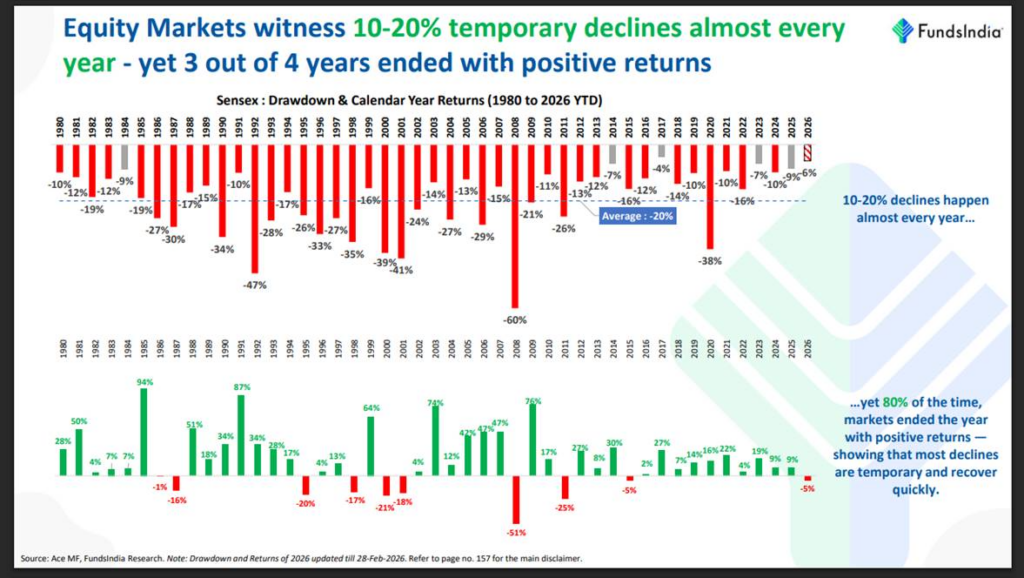
The chart below covers the Sensex from 1980 to 2026. Every red bar above the x-axis represents how far the market fell during that year — its ‘drawdown.’ The green and red bars below show what the market actually returned by year-end.
Source: Ace MF, FundsIndia Research — Sensex Drawdown & Calendar Year Returns (1980–2026 YTD)
The data shows that a 10–20% intra-year fall happens almost every single year without exception. The average drawdown over 46 years is approximately 20%. This is not an aberration. This is the norm.
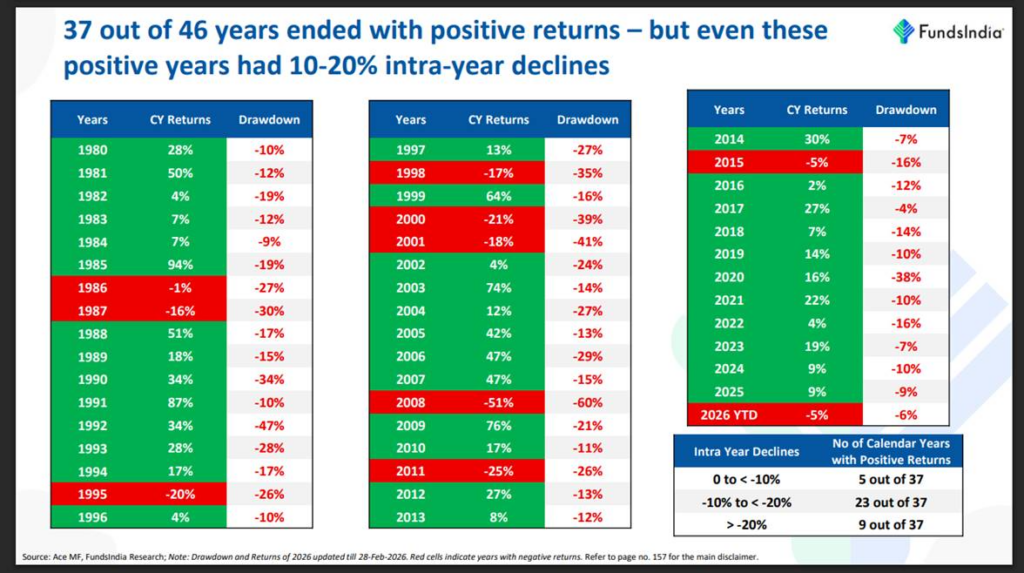
And yet — 37 out of 46 years ended with positive returns. That’s 80% of the time. The falls that felt like disasters in real time turned out to be temporary. The market recovered. It moved on. It compounded.
Source: Ace MF, FundsIndia Research — 37 out of 46 years ended positive, even with 10–20% intra-year declines
Look at the table carefully. Take 1985 — the market fell 19% during the year. It still ended up 94%. Take 1991 — a 10% drawdown, but 87% returns. Take 2003 — a 14% fall mid-year, 74% annual return. Even 2020, which brought a savage 38% drawdown at the peak of COVID fears, ended the year with 16% gains.
The first investor, Akshay — the one who has been watching and waiting — has been sitting on the sidelines through year after year of exactly this pattern. He has been seeing the red bars (the scary falls) and missing the green ones (the recoveries). Read More: Is there any relationship between Bear markets and Economic recession?
Volatility is not a warning sign. For a long-term investing, it is simply the price of admission.
FEAR #2 — What if the market crashes after I invest?
Every big fall has recovered — faster than you think
This is the fear that keeps Ranbir up at night. He started investing last year, and since then, the markets have been seeing “Trump Effect”, and he is wondering whether he made a terrible mistake. The data has a direct and emphatic answer for him.
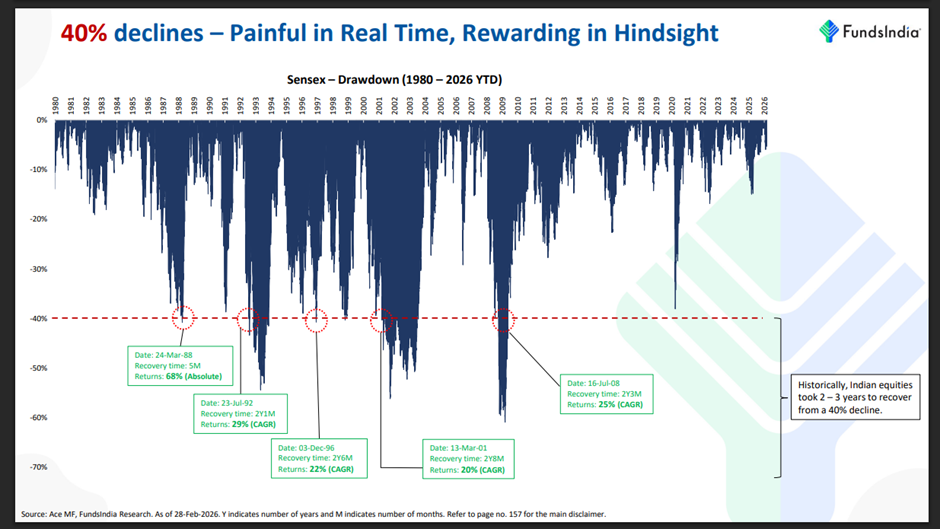
The following chart tracks every significant market decline in the Sensex’s history — specifically those that crossed the 40% threshold. Against each fall, they record the recovery time and the returns generated from that low point.
Source: Ace MF, FundsIndia Research — Every 40%+ decline recovered within 2–3 years, returns of 20–68%
This chart carries one loud, consistent message: every fall, without exception, has been followed by a recovery. The more severe the fall, the sharper the bounce. The 2008 Global Financial Crisis — a near 60% drawdown — recovered in about 2 years and 4 months with 16% CAGR returns from the bottom. The COVID crash of March 2020 recovered in just 6 months with 43% absolute returns.
Historically, Indian equities took roughly 2–3 years to recover from even the deepest crashes. For a long-term investing, someone with a horizon of 7, 10, or 15 years — this is not a risk. It is a temporary interruption in the journey.
For the new investor who is anxious about starting at the ‘wrong time’, the data has a simple answer: even the worst entry point in history has never resulted in a permanent loss for someone who stayed invested. (Discussed in detail as Fear # 4) Read More: Financial Freedom: A Journey of Responsibility and Minimalism
FEAR #3 — The news is too scary. Geopolitics, wars, crises… How can I invest now?
There has never been a ‘safe’ news cycle to invest in
This is where Akshay’s story becomes almost textbook. Russia-Ukraine. India-Pakistan tensions. Trump tariffs. Each time he was ready to invest, a headline pulled him back. He is not alone — this is one of the most common reasons investors delay for years.
The chart below is perhaps the most powerful one. It maps the Sensex’s journey from 1990 to 2026 and annotates every major geopolitical event, financial crisis, and market shock along the way.
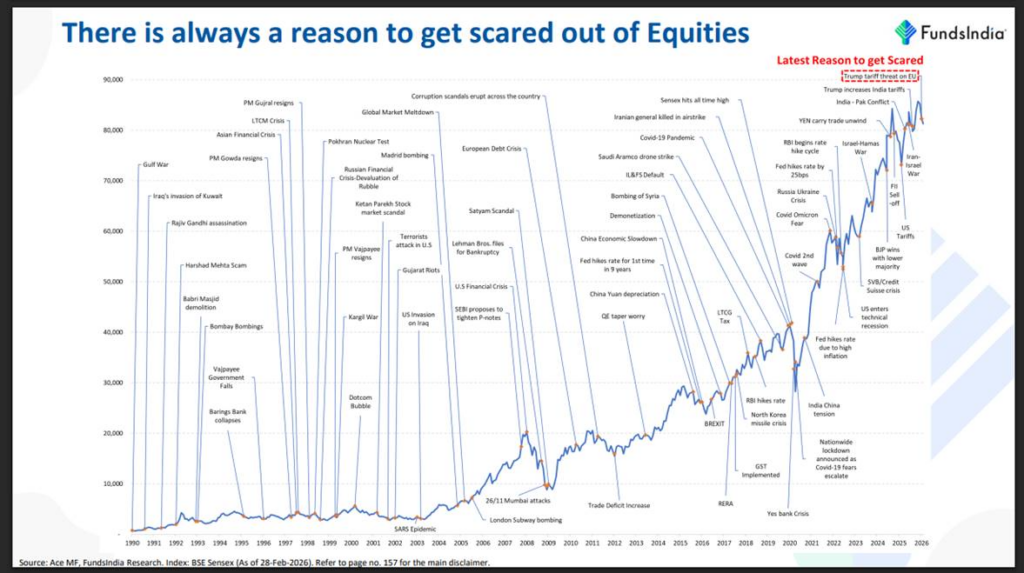
Source: Ace MF, FundsIndia Research — There has always been a reason to stay out of equities. The Sensex went up regardless.
Look at that chart and count the crises. The Gulf War. Babri Masjid demolition. Harshad Mehta scam. Kargil War. Dotcom Bubble. SARS epidemic. 26/11 Mumbai attacks. The Global Financial Crisis. IL&FS default. COVID-19 pandemic. Russia-Ukraine crisis. Fed rate hikes. Israel-Hamas war. India-Pakistan conflict. Trump tariffs.
The Sensex went from under 2,000 in 1990 to over 85,000 by 2026. Every single one of those ‘reasons to stay out’ was eventually overcome by the underlying strength of the economy and corporate earnings.
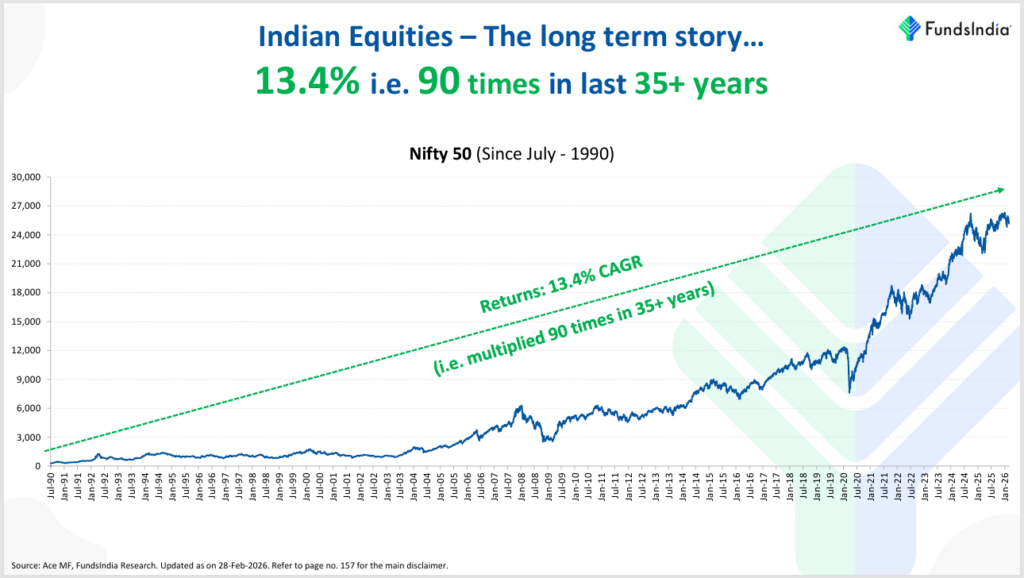
If you had waited for the news to turn good before investing, you would have waited forever — and missed one of the greatest wealth-creation opportunities in history.
The lesson here is not that geopolitics doesn’t matter. It does, in the short term. The lesson is that for long-term equity investors, geopolitical noise has never determined long-term investing returns. The trend line of India’s economy is what has determined it.
The real risk isn’t in the market. The real risk is in the investor’s own behaviour — the habit of seeing risk in real time and returns only in hindsight.
FEAR #4 — What if I invest just before a crash?
The worst-case scenario is still better than not investing at all
Let’s directly answer the question that haunts every investor at market highs: “What if I put in my money right before the market crashes?”
The FundsIndia report modelled exactly this scenario — across every major crash since 2000. They tracked what would have happened if you had invested at the absolute peak, just before each crisis hit.
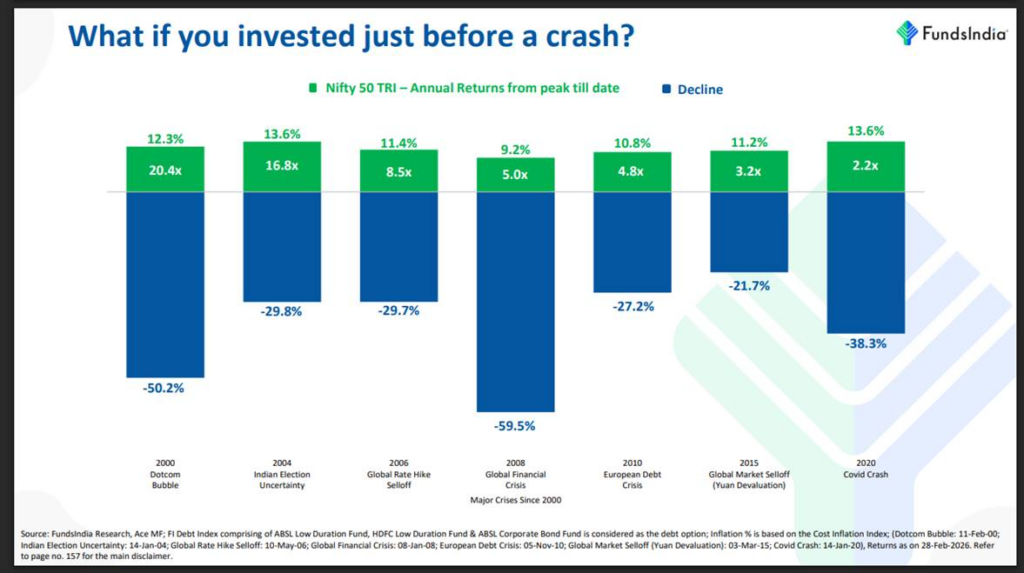
Source: FundsIndia Research, Ace MF — Nifty 50 TRI annual returns from peak till date across major crises since 2000
The results should permanently silence the fear of ‘bad timing’:
• Invested just before the 2000 Dotcom Bubble? Your money grew 20.4x (12.3% CAGR).
• Invested before the 2004 Indian Election Uncertainty? Grew 16.8x (13.6% CAGR).
• Invested before the 2008 Global Financial Crisis — one of the worst crashes in history? Still grew 5.0x (9.2% CAGR).
• Invested before the 2020 COVID Crash? Grew 2.2x (13.6% CAGR) — in just 5 years.
Not a single scenario resulted in a long-term loss. Yes, there was pain in the short term sometimes severe pain. But every single investor who stayed invested came out ahead.
The data is unambiguous: for long-term investing, even the worst entry point in history has rewarded patience.
FEAR #5 — I should step out now and come back at a better time.
The cost of missing just a few ‘best days’
This is perhaps the most important piece of data. When investors try to time the market — getting out or stopping investing during bad patches with the intention of getting back in for the good days — they almost inevitably miss the market’s best days. And missing just a few of those days is catastrophically expensive.
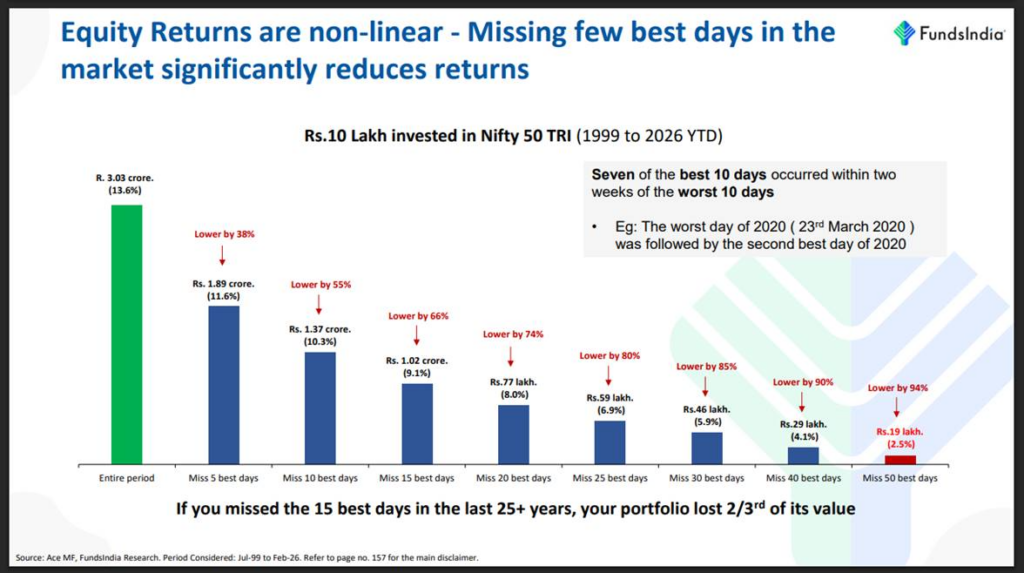
Source: Ace MF, FundsIndia Research — Rs.10 lakh invested in Nifty 50 TRI, 1999–2026. Missing best days slashes wealth dramatically.
If you had invested Rs. 10 lakh in the Nifty 50 TRI in July 1999 and stayed invested through all the volatility — the crashes, the corrections, the scary headlines — your investment would have grown to Rs. 3.03 crore (13.6% CAGR) by early 2026.
Now consider what happens when you try to be clever:
• Miss just the 5 best days: your corpus drops 38% to Rs. 1.89 crore.
• Miss the 10 best days: Rs. 1.37 crore — a 55% reduction.
• Miss the 15 best days: You lose two-thirds of your wealth. Rs. 1.02 crore.
• Miss 50 best days: Rs. 19 lakh. You would have barely beaten the original investment after 25+ years.
The most critical insight: 7 of the 10 best days in the market occurred within two weeks of the 10 worst days. The biggest gains happen right after the biggest falls. The investor who steps out in fear to ‘avoid the crash’ is almost certain to miss the recovery that follows immediately.
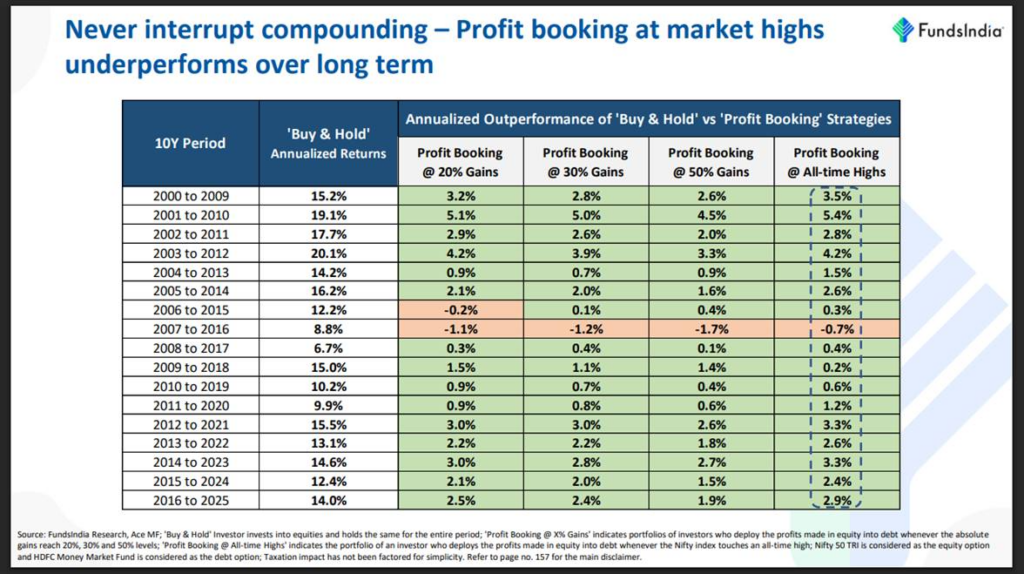
Source: FundsIndia Research, Ace MF — Buy & Hold consistently outperforms profit-booking strategies across every 10 years
The above table makes the same point from a different angle. Across every rolling 10-year period from 2000 to 2025, a simple Buy & Hold strategy — staying invested, doing nothing — outperformed every profit-booking strategy in most periods. Whether you booked profits at 20% gains, 30% gains, 50% gains, or every all-time high, you almost always ended up with less wealth than someone who simply… stayed.
The power of compounding is not a myth. But it only works if you refuse to interrupt it. Read More: The Truth About Compounding in Mutual Funds: It’s Not What You Think
THE REAL INSIGHT — A SHIFT IN PERSPECTIVE
Akshay has been watching the markets for years, waiting for the right moment that never seems to arrive. Forty-six years of data have one clear message for him: the perfect time was never coming. It doesn’t exist. What exists is time spent in the market — and every year he spent waiting, that time worked against him.
Ranbir started investing just a year ago and is already second-guessing himself. The data has something equally clear to say to him: the only wrong move would have been never starting. He has already done the hard part. Now the only job is to stay the course.
What both of them are really dealing with is not a market problem — it is an investor behaviour problem. When you are living through a fall, it feels like it will never end. When the recovery comes, it always feels obvious in hindsight. We experience risk in the present tense and return only looking backwards. That gap — between what the market feels like in the moment and what it actually delivers over time — is where most investment decisions go wrong. Read More: The Distracted Investor: Always Confused, Rarely Profitable
The market will give you reasons to be afraid. It always has, and it always will. The question is whether you let that fear cost you what patience could have built. Because the truth is, the market has never waited for anyone to feel ready — and the investor who kept waiting for the risk to disappear was, without realising it, creating a different kind of risk entirely: the risk of never starting. He believed this moment was uniquely risky, that the right time was just around the corner. But the rise almost always comes immediately after the fall. The deeper the fear, the closer the recovery.
The shift that changes everything is surprisingly simple: stop reading the present as a warning and start reading the past as evidence. The data is not asking you to be fearless. It is just showing you, across 46 years and every crisis imaginable, that fear has never once been the right reason to stop.
See the past for what it is — proof that markets recover. And see the present not as danger, but as the next chapter in the same long story.
Always remember – The four most dangerous words in investing are: ‘This time it’s different. ‘” – Sir John Templeton
Stay invested. Stay patient. Don’t interrupt compounding.
Credit: This article is written by Ms Sudhiti Kanungo, Financial Planning Intern, Good Moneying