But again this article leaves the RNOR concept unexplained as does so many other blogs.
Can you highlight under what conditions does a returning NRI stay as RNOR for a period of 3 years? From the Income Tax rules, it’s just not possible to have 3 year RNOR status, unless you go abroad for a few months. Thanks
Hi Sachin
RNOR status is essentially a transition phase from being non-resident to being a resident (ROR).
As per Section 6 of the Income Tax Act, there can be two types of residents.
Resident and Ordinarily Resident (ROR)
Resident but not Ordinarily Resident (RNOR)
You are RNOR if you satisfy any of the following two conditions:
You have been a non-resident (NRI) in 9 out of 10 previous years preceding that year.
You have, during the previous 7 years preceding that year, been in India for a period of 729 days or less.
So, essentially, you first determine whether you are a resident or non-resident. If you are a resident, you must determine whether you are ROR or RNOR.
FEMA has only two classifications: Resident and Non-Resident (Resident outside India).
Income Tax Act has three classifications: ROR, RNOR and NRI.
Does RNOR status affect taxation?
Very much. RNOR are almost treated like NRIs when it comes to taxation.
As per Section 10(15)(iv)(fa) of the Income Tax Act, the interest on foreign currency deposits in Indian Banks is exempt for non-residents and RNOR.
Hence, interest on FCNR deposits will continue to be exempt from tax as long as you remain RNOR. Similarly, interest earned on RFC account will be exempt from income tax as long as you are RNOR.
Since RNOR get favourable tax treatment (as compared to ROR), you can time your return in a way that you stay RNOR for as long as possible.
Illustration: RNOR Status
If you are returning after being NRI for 5 continuous years or less, you become a resident (ROR) immediately (as per Income Tax Act).
If you are returning to India after being NRI for 6 continuous years, you can become RNOR for one year. Subsequently, you become ROR.
If you are returning to India after being NRI for say 20 continuous years, you can become RNOR for two years. Subsequently, you become ROR.
In extreme cases, if you are returning after being NRI for 5 years or more (and didn’t visit India during those years) and return to India after April 2, you can be RNOR for maximum three years.
Please understand there are specific numbers involved in determining residential status.
This is best understood with the help of an example.
You have been staying abroad for 20 years and didn’t come to visit India even once during those 20 years. You return to India on June 1, 2015. You would obviously qualify as NRI for the last 10 years from FY2006 to FY2015.
FY2016 (ending March 31, 2016): Since you have been in India for more than 182 days (305 days), you qualify as a Resident for FY2016. But which type of resident? You were non-resident for all 10 previous years (FY2006 to FY2015) preceding that year (FY2016). Hence, you are RNOR.
FY2017 (ending March 31, 2017): Since you have been in India for more than 182 days (365 days), you qualify as a Resident for FY2017. You were non-resident for 9 out of 10 previous years (FY2007 to FY2016) preceding that year (FY2017). Hence, you are RNOR.
FY2018 (ending March 31, 2018): Since you have been in India for more than 182 days (365 days), you qualify as a Resident for FY2018. But which type of resident? You were non-resident for 8 out of 10 previous years (FY2008 to FY2017) preceding that year (FY2018). The condition is not met. However, there is an additional condition. During 7 previous years (FY2011 to FY2017), you were in India for 670 days (305 in FY2016 + 365 in FY2017), which is less than 729 days. Hence, you are RNOR.
FY2019 (ending March 31, 2019): Since you have been in India for more than 182 days (365 days), you qualify as a Resident for FY2019. But which type of resident? You were non-resident for 7 out of 10 previous years (FY2009 to FY2018) preceding that year (FY2019). The condition is not met. However, there is an additional condition. During 7 previous years (FY2012 to FY2018), you were in India for 1,035 days (305 in FY2016 + 365 in FY2017 + 365 in FY2018), which is more than 729 days. Hence, you are ROR.
You can be RNOR for a maximum of three years.
Hi Sir,
Thanks for your article.
I left India on 10th September 2009 to Singapore and till 27th March 2018 continuously stayed outside India except 30 days(average) of my vacation in India every year. I am still continuing my abroad employment even now but I stay in India most of the time and from April 2018 to till today(1st November 2018) stayed in India for 142 days. Most likely I can not stay more than 183 days outside India in this financial year(2018-2019). In such case what will be my resident status as per Income tax and FEMA considering I am still continuing my abroad employment but only my stay in India is more than 183 days. What is to be done with my NRE and NRO accounts? Should I change them to RFC account. Should I file income tax returns for financial year 2018-2019? If I will be considered as RNOR for income tax purpose? Since I am contnuing my abroad employment I will stay in India less than 183 days during next financial year(2019-2020) to avoid income tax in India.
Hi Mohan. See, when you are continuing your abroad employment, and being paid from Singapore only, and also you intend to stay outside India from next year onwards, so it is very much clear from FEMA perspective you are an NRI and from Income Tax for this year you would be RNOR. I do not think you need to convert your NRE/NRO account as those are governed by FEMA only.
Yes, you should file ITR in India for FY 2018-19. And be in touch with a Good CA if he advises you to do some more formalities (If any)
Thanks
Hi Sir, Many thanks for your clarification. I do not have any taxable income in India.
Is it necessary to file IT returns for FY 2018-19.
Thanks
No. If there’s no Income in India, No Need to file ITR
Many thanks for your reply.
Manikaranji, Kindly advise on my following Questions.
My daughter was in service in India for April & May ie two months in this FY 2018-19 . Then She left the job and entered into a software consultancy agreement on 1st June 18 which was to be done online. fees was to be payable in India in Indian currency and in Indian Bank. She left India on 15th June 2018 and did consultancy job online whilst residing in Canada. Consultancy Job lasted upto Sep 2018.
She Joined service in Canada in October 18. As on date she is NRI as her stay , out of India is more than 180 days.
1. Tax treatment on following which are earned in India in Indian Currency
i) Salary Income,
ii) Consultancy job ( even not residing in India),
iii) FD/ Saving Interest,
iv) Dividend on Stock/ MF.
v) Short term and long term Capital Gain/ Loss
vi) All Income Tax treatment on the salary earned in Canada.
2. Whether this Canadian Income is to be declared in Indian ITR.
3. What about Bank accounts in India. When to convert these in NRE a/c
4. If Canadian Income is brought in India what would be tax treatment on such repartition and Income generated from such Capital inflowed.
5. Any other main point and advise.
See, to consider one as an NRI, especially in the first year of stay outside India, sometimes one falls into the second condition of stay in India for 60 days or more in the year and for a period of 365 days or more in the 4 years preceding the relevant financial year. So you better confirm the Residency status from your CA.
The answer to your tax questions will depend on the residency status
However, to your 3rd question. Yes the bank accounts need to be converted to NRO a/c
Hey Mohan!
I have a confusing case. I have been in US for last 4 years (from August 2015 till today). I studied from Aug 2015 till December 2016 and started working in US on student visa afterwards. I converted to H1B on October 2018. In FY 2018-2019, I visited India for the period of 55 days when I had permanent employment in US. I am planning to move to India permanently sometime around mid February 2019. In this case, will I be exempted from the 60 days clause since I had left India for employment purpose or will I be treated as resident since I am returning back to India for permanent employment? In my case leaving India for permanent employment and returning back to India for permanent employment is happening in the same FY. Please advise.
Hey Manikaran!
I have a confusing case. I have been in US for last 4 years (from August 2015 till today). I studied from Aug 2015 till December 2016 and started working in US on student visa afterwards. I converted to H1B on October 2018. In FY 2018-2019, I visited India for the period of 55 days when I had permanent employment in US. I am planning to move to India permanently sometime around mid February 2019. In this case, will I be exempted from the 60 days clause since I had left India for employment purpose or will I be treated as resident since I am returning back to India for permanent employment? In my case leaving India for permanent employment and returning back to India for permanent employment is happening in the same FY. Please advise.
Hi Shubada
As per my Understanding, The Kind of Visa you have does not impact your residency status. Means FEMA looks at the intention and You have become NRI the day you left India in Aug 2015 and Income tax would look at the days you reside outside India. So you have been an NRI in the last few years.
Now when you are coming back for good, in this case, I think again FEMA will look at the intention and you will be Resident from its perspective, whereas Income tax will look at the days you were in India.
Hi Manikaran,
First of all, let me thank you for being one of the very few who have explained this so well for returning Indians. Now, I have a scenario in mind and would like to get your view on the same. Let’s assume an individual left India for employment in mid 2017 and travelled to Singapore. If that person were to return in April 2019 to India on a permanent basis, what would be his tax liability for the income earned in Singapore in the previous Indian FY, i.e 2018-19? Also, if that person were to return in March 2019, what would be his tax liability in India for income earned in Indian FY 2018-19? It would be great if you could share some thoughts on both situations.
Appreciate your effort to help people in the absence of any clear sources of information on this really important topic.
Hi Ranjit
I am glad you found this article useful.
Coming to your query, Assuming that you left for Singapore on 30.06.2017 for employment purpose and Plans to come back for good in April 2019, then you will be treated as NRI in FY 2017-18 as well as 2018-19. and thus your income in Singapore will not be clubbed in Indian income (If there’s any). No change in taxation, even if you return in March 19.
Dear Sir,
I am an NRI and a postdoctorate in technology Ph.D., working and living in Saudi Arabia for a manufacturing company for 18+ years.
I have been out of India since 1995, pursued post-graduate studies from the USA. I was in there until 2001 and relocated to Saudi Arabia. About my current job profile, Apart from my regular job, I conduct various consultancy training, audits across the world during my vacation period ( no issue with my present employer). I have earned substantial income over the years and parked my funds in Indian banks under NRE accounts. I have no rental income from India as I do not have any properties there, hence no taxable income arising from India.
As I understand, revenue generated interest in these banks are 100% tax-free and FEMA compliant. The earnings from personal audits are also parked along with my earnings from current job in these banks.
I have a few questions:
Since I have a very good clientele network across the world, I have been earning forex (US$ & Euros and GBP) thru my personal visits to client locations by issuing personal invoices. I have been issuing invoices in my name only. My question is: “am I liable to pay taxes in India on the income earned by foreign clients?” All monies (salaries and consultancy fees) are being transferred directly by my clients into my existing NRE accounts in India.
Please advise if I can continue to receive monies (forex only) from my international client network. I cannot transfer the forex earnings into Saudi bank and then remit to India as per the prevailing restrictions of local banks in SAUDI.
I am taking up consultancy engagement with companies based in U.K, Japan, China and the USA, they will be depositing the consulting fee in Euros / USD into my NRE bank account directly. Since I am an NRI, will I have to pay taxes on this income?
Also while searching on the internet I found that
The scope of total income.
5. (1) Subject to the provisions of this Act, the total income of any previous year of a person who is a resident includes all income from whatever source derived which—
(a) is received or is deemed to be received in India in such year by or on behalf of such person; or
(b) accrues or arises or is deemed to accrue or arise to him in India during such year; or
(c) accrues or arises to him outside India during such year :
Provided that, in the case of a person not ordinarily resident in India within the meaning of sub-section (6)* of section 6, the income which accrues or arises to him outside India shall not be so included unless it is derived from a business controlled in or a profession set up in India.
(2) Subject to the provisions of this Act, the total income of any previous year of a person who is a non-resident includes all income from whatever source derived which—
(a) is received or is deemed to be received in India in such year by or on behalf of such person; or
(b) accrues or arises or is deemed to accrue or arise to him in India during such year.
Explanation 1.—Income accruing or arising outside India shall not be deemed to be received in India within the meaning of this section by reason only of the fact that it is taken into account in a balance sheet prepared in India.
Explanation 2.—For the removal of doubts, it is hereby declared that income which has been included in the total income of a person on the basis that it has accrued or arisen or is deemed to have accrued or arisen to him shall not again be so included on the basis that it is received or deemed to be received by him in India.
I have not got this answer anywhere on the portals. If you can help. I have been a resident in UAE since 6th June 2017 and would be returning for good on 5th June this year. Will i have to file the salary income from april-june 2019 as taxable in India. Or I dont need to show this income in India.
Can salary in USD be credited in resident savings account in India?
I had been working in Merchant navy and my salary
Since you are a merchant navy person, as pr your stay in India, we understand that you are an NRI and you have to open an NRE account to get your salary credited in USD.
hello sir if I stay more then 180 out of india, but I filling ITR regularly then sir I get any problem in immigration in india to clear
stay out of india more then 180 days but not NRI
Filling ITR has nothing to do with the residential status of an Individual.
Dear sir, I am a retired person of 7 years old was in India from 2005 Nov till 2016 May and made on 6 months visit to my son in USA 3 or 4 times 2006 to 2010. In 2016 May my visit visa expires and hence I made a final visit during which time my son applied for GREEN CARD to live with him. After applying I returned back to India on Advance Peroll for 1 year. I got my GREEN CARD allowing me PERMANENT RESIDENT from 14th Sept.2017 till 14.09.2027 for 10 years under category IRO. i HAVE COME ONLY TO STAY WITH MY SON FOR 10 YEARS AND NOT FOR EMPLOYMENT OR FOR ANY MONETARY BENEFIT. Am I NRI or RESIDENT NOT ORDINARY RESIDENT OR RESIDENT. In USA Govt rules changes and at any time they may waive GCs ALSO like they are likely take back H4 visa for the spouse of HIB visa holders. Please write my status? Best regards SRINIVASAN SUBRAMANIAN
10 years is a very long time Sir. In my understanding, you will be considered as NRI.
What’s the exact difference between the NRI and Expact… In terms of Taxation point of view..
There is an Non resident indian employee in indian company working in USA and service is rendered outside india does the indian company has to tax it or it should be exempted from tax?
If a person is Non-Resident then no income tax to be deducted on the income earned outside India. Income tax applies to NRI only if the income earned or accrues in India. In your case, on the face of it, the income is earned on the services rendered outside India so it should be treated as Income earned out of India.
Dear Sir,
Thanks a lot for clear explanation on Residential status with examples.
I am working for Oil field company in Basra, Iraq. My job nature demands 28/28 On/Off. It means after deducting travelling days, my period of stay in India comes around 175-180 days in a financial year.
Because of Covid-19 situation, I returned from Basra, on mid of March 2020. I am waiting for Normal situation to go back to work. Till date, I am working from home (from India) for the same company. Now my salary is being credited to my NRE account for the service rendered to the company located outside India.
1) In Financial Year 2020-21, what will be my residential status (in case if I am staying in India till December 2020 due to Covid-19 situation)?
2)Is my foreign income taxable in India?
3)Is there any guidelines given by CBDT on this Covid-19 restriction?
Thanking you Sir,
Kind Regards,
Hariharan Arunachalam
Hello Hariharan
The answer to your question lies in your Residency status in past years. If you stay till December 2020 may attract 183 days rule, but to me, it seems that you must be satisfying the RNOR criteria, as mentioned in the article.
If yes, then your salary though being received in the NRE account will not be taxed in India.
For Covid 19 the only guidelines issued were regarding not going back due to cancellation of the air travel. https://www.business-standard.com/article/economy-policy/covid-19-relief-for-nris-foreign-visitors-as-tax-residency-rules-eased-120050900066_1.html
This is a unique situation worldwide. See, since your being a resident in India would not be by choice but forced upon you by the situation, so if you do not fall in RNOR rules then you may get the relief by appealing to the assessing officer. Still, I would suggest you better be in touch with your Chartered Accountant, so help you in the appealing process if required., and may guide you better in today’s situation and tax rules.
In any case, your intention is to go back as and when the work calls you, so as per FEMA you will be an NRI only.
Hope this answers your query.
Thanks a lot Sir for clear explanation and guiding for the Way forward !!!
Kind Regards,
Hariharan Arunachalam
Hi My name is Josemon Skaria, An NRE from Kerala, at present Ia m working at Muscat, I need your advice to invest my money which I can get maximum return with NRE protection and no risk
Hi Josemon, I would be glad to advise you, but I am afraid, I can’t fulfil the condition of “Maximum Return”, with “No Risk”. In fact, this is not the right expectation. There’s no such product, which can get you both this. It’s always wise to be aware of the risk and take the calculated call. Nothing is devoid of risk…don’t fall into a missellers trap who promise you to provide with both .
In case you would like to discuss further, you may email me at info@goodmoneying.com
Hi,
student studying at Canada Since last 3 year & student come in india once in a year,So its called NRI or Not ?
Hello sir, I am a nurse working in Saudi Arabia from June 2020. Can you please let me know if I fall under the category of NRI.
Also, if i won any prize money out of any lottery conducting in middle east (like Abu Dhabi Big ticket) will that be taxable in India?
Thanks
Binoj
Hi Binoj,
Since you have moved abroad for employment purposes and had already spent 182 days there then you would be considered an NRI and you do not have to pay taxes on your foreign income in India but do check the taxation in your country of residence.
Hello,
I have moved to the US on a green card in Sept 2019. I have business both in the US and India. I have stayed less than 179 days in India in FY 2020-21. My income in India is greater than 15 lacs for FY 2020-21. I do not satisfy the 2nd condition of the IT act for NRI as my stay in India is more than 365 days in the last 4 years.
I visit India often and I am unclear on my NRI status. Can you guide me for the following,
a) Do I report my US income in India and pay taxes on my US income?
b) How many days in a financial year can I stay in India?
Thank you,
Jay
Hi Jay,
Since you do have business in India and your income in India is more than 15 lakhs, the first condition would be that your stay in India shall not exceed 120 days to be considered as an NRI. You may check your status from the income tax website link shared below by entering your stay details in India. This would be the most authentic source to guide you on your residential status. https://www.incometaxindia.gov.in/Pages/tools/residential-status-calculator.aspx
If the status is Indian Resident then you need to pay tax on your global income. Else, only the income accrued in India shall be taxable.
Ideally, to maintain NRI status, your stay in India shall be less than 120 days in a Financial Year.


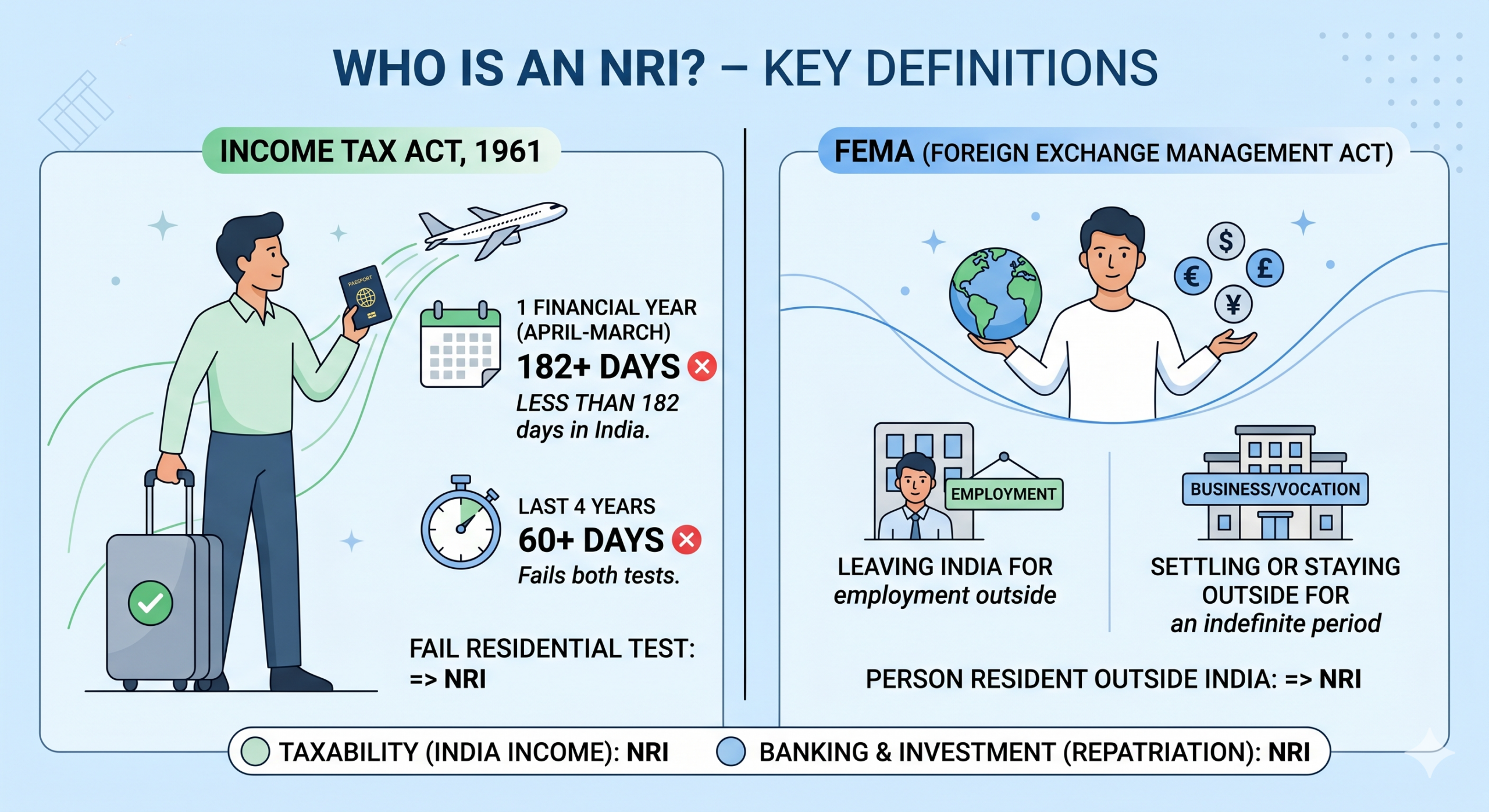




Good article, thank you.
But again this article leaves the RNOR concept unexplained as does so many other blogs.
Can you highlight under what conditions does a returning NRI stay as RNOR for a period of 3 years? From the Income Tax rules, it’s just not possible to have 3 year RNOR status, unless you go abroad for a few months. Thanks
Hi Sachin
RNOR status is essentially a transition phase from being non-resident to being a resident (ROR).
As per Section 6 of the Income Tax Act, there can be two types of residents.
Resident and Ordinarily Resident (ROR)
Resident but not Ordinarily Resident (RNOR)
You are RNOR if you satisfy any of the following two conditions:
You have been a non-resident (NRI) in 9 out of 10 previous years preceding that year.
You have, during the previous 7 years preceding that year, been in India for a period of 729 days or less.
So, essentially, you first determine whether you are a resident or non-resident. If you are a resident, you must determine whether you are ROR or RNOR.
FEMA has only two classifications: Resident and Non-Resident (Resident outside India).
Income Tax Act has three classifications: ROR, RNOR and NRI.
Does RNOR status affect taxation?
Very much. RNOR are almost treated like NRIs when it comes to taxation.
As per Section 10(15)(iv)(fa) of the Income Tax Act, the interest on foreign currency deposits in Indian Banks is exempt for non-residents and RNOR.
Hence, interest on FCNR deposits will continue to be exempt from tax as long as you remain RNOR. Similarly, interest earned on RFC account will be exempt from income tax as long as you are RNOR.
Since RNOR get favourable tax treatment (as compared to ROR), you can time your return in a way that you stay RNOR for as long as possible.
Illustration: RNOR Status
If you are returning after being NRI for 5 continuous years or less, you become a resident (ROR) immediately (as per Income Tax Act).
If you are returning to India after being NRI for 6 continuous years, you can become RNOR for one year. Subsequently, you become ROR.
If you are returning to India after being NRI for say 20 continuous years, you can become RNOR for two years. Subsequently, you become ROR.
In extreme cases, if you are returning after being NRI for 5 years or more (and didn’t visit India during those years) and return to India after April 2, you can be RNOR for maximum three years.
Please understand there are specific numbers involved in determining residential status.
This is best understood with the help of an example.
You have been staying abroad for 20 years and didn’t come to visit India even once during those 20 years. You return to India on June 1, 2015. You would obviously qualify as NRI for the last 10 years from FY2006 to FY2015.
FY2016 (ending March 31, 2016): Since you have been in India for more than 182 days (305 days), you qualify as a Resident for FY2016. But which type of resident? You were non-resident for all 10 previous years (FY2006 to FY2015) preceding that year (FY2016). Hence, you are RNOR.
FY2017 (ending March 31, 2017): Since you have been in India for more than 182 days (365 days), you qualify as a Resident for FY2017. You were non-resident for 9 out of 10 previous years (FY2007 to FY2016) preceding that year (FY2017). Hence, you are RNOR.
FY2018 (ending March 31, 2018): Since you have been in India for more than 182 days (365 days), you qualify as a Resident for FY2018. But which type of resident? You were non-resident for 8 out of 10 previous years (FY2008 to FY2017) preceding that year (FY2018). The condition is not met. However, there is an additional condition. During 7 previous years (FY2011 to FY2017), you were in India for 670 days (305 in FY2016 + 365 in FY2017), which is less than 729 days. Hence, you are RNOR.
FY2019 (ending March 31, 2019): Since you have been in India for more than 182 days (365 days), you qualify as a Resident for FY2019. But which type of resident? You were non-resident for 7 out of 10 previous years (FY2009 to FY2018) preceding that year (FY2019). The condition is not met. However, there is an additional condition. During 7 previous years (FY2012 to FY2018), you were in India for 1,035 days (305 in FY2016 + 365 in FY2017 + 365 in FY2018), which is more than 729 days. Hence, you are ROR.
You can be RNOR for a maximum of three years.
Hi Sir,
Thanks for your article.
I left India on 10th September 2009 to Singapore and till 27th March 2018 continuously stayed outside India except 30 days(average) of my vacation in India every year. I am still continuing my abroad employment even now but I stay in India most of the time and from April 2018 to till today(1st November 2018) stayed in India for 142 days. Most likely I can not stay more than 183 days outside India in this financial year(2018-2019). In such case what will be my resident status as per Income tax and FEMA considering I am still continuing my abroad employment but only my stay in India is more than 183 days. What is to be done with my NRE and NRO accounts? Should I change them to RFC account. Should I file income tax returns for financial year 2018-2019? If I will be considered as RNOR for income tax purpose? Since I am contnuing my abroad employment I will stay in India less than 183 days during next financial year(2019-2020) to avoid income tax in India.
Hi Mohan. See, when you are continuing your abroad employment, and being paid from Singapore only, and also you intend to stay outside India from next year onwards, so it is very much clear from FEMA perspective you are an NRI and from Income Tax for this year you would be RNOR. I do not think you need to convert your NRE/NRO account as those are governed by FEMA only.
Yes, you should file ITR in India for FY 2018-19. And be in touch with a Good CA if he advises you to do some more formalities (If any)
Thanks
Hi Sir, Many thanks for your clarification. I do not have any taxable income in India.
Is it necessary to file IT returns for FY 2018-19.
Thanks
No. If there’s no Income in India, No Need to file ITR
Many thanks for your reply.
Manikaranji, Kindly advise on my following Questions.
My daughter was in service in India for April & May ie two months in this FY 2018-19 . Then She left the job and entered into a software consultancy agreement on 1st June 18 which was to be done online. fees was to be payable in India in Indian currency and in Indian Bank. She left India on 15th June 2018 and did consultancy job online whilst residing in Canada. Consultancy Job lasted upto Sep 2018.
She Joined service in Canada in October 18. As on date she is NRI as her stay , out of India is more than 180 days.
1. Tax treatment on following which are earned in India in Indian Currency
i) Salary Income,
ii) Consultancy job ( even not residing in India),
iii) FD/ Saving Interest,
iv) Dividend on Stock/ MF.
v) Short term and long term Capital Gain/ Loss
vi) All Income Tax treatment on the salary earned in Canada.
2. Whether this Canadian Income is to be declared in Indian ITR.
3. What about Bank accounts in India. When to convert these in NRE a/c
4. If Canadian Income is brought in India what would be tax treatment on such repartition and Income generated from such Capital inflowed.
5. Any other main point and advise.
See, to consider one as an NRI, especially in the first year of stay outside India, sometimes one falls into the second condition of stay in India for 60 days or more in the year and for a period of 365 days or more in the 4 years preceding the relevant financial year. So you better confirm the Residency status from your CA.
The answer to your tax questions will depend on the residency status
However, to your 3rd question. Yes the bank accounts need to be converted to NRO a/c
Hey Mohan!
I have a confusing case. I have been in US for last 4 years (from August 2015 till today). I studied from Aug 2015 till December 2016 and started working in US on student visa afterwards. I converted to H1B on October 2018. In FY 2018-2019, I visited India for the period of 55 days when I had permanent employment in US. I am planning to move to India permanently sometime around mid February 2019. In this case, will I be exempted from the 60 days clause since I had left India for employment purpose or will I be treated as resident since I am returning back to India for permanent employment? In my case leaving India for permanent employment and returning back to India for permanent employment is happening in the same FY. Please advise.
Hey Manikaran!
I have a confusing case. I have been in US for last 4 years (from August 2015 till today). I studied from Aug 2015 till December 2016 and started working in US on student visa afterwards. I converted to H1B on October 2018. In FY 2018-2019, I visited India for the period of 55 days when I had permanent employment in US. I am planning to move to India permanently sometime around mid February 2019. In this case, will I be exempted from the 60 days clause since I had left India for employment purpose or will I be treated as resident since I am returning back to India for permanent employment? In my case leaving India for permanent employment and returning back to India for permanent employment is happening in the same FY. Please advise.
Hi Shubada
As per my Understanding, The Kind of Visa you have does not impact your residency status. Means FEMA looks at the intention and You have become NRI the day you left India in Aug 2015 and Income tax would look at the days you reside outside India. So you have been an NRI in the last few years.
Now when you are coming back for good, in this case, I think again FEMA will look at the intention and you will be Resident from its perspective, whereas Income tax will look at the days you were in India.
Hi Manikaran,
First of all, let me thank you for being one of the very few who have explained this so well for returning Indians. Now, I have a scenario in mind and would like to get your view on the same. Let’s assume an individual left India for employment in mid 2017 and travelled to Singapore. If that person were to return in April 2019 to India on a permanent basis, what would be his tax liability for the income earned in Singapore in the previous Indian FY, i.e 2018-19? Also, if that person were to return in March 2019, what would be his tax liability in India for income earned in Indian FY 2018-19? It would be great if you could share some thoughts on both situations.
Appreciate your effort to help people in the absence of any clear sources of information on this really important topic.
Hi Ranjit
I am glad you found this article useful.
Coming to your query, Assuming that you left for Singapore on 30.06.2017 for employment purpose and Plans to come back for good in April 2019, then you will be treated as NRI in FY 2017-18 as well as 2018-19. and thus your income in Singapore will not be clubbed in Indian income (If there’s any). No change in taxation, even if you return in March 19.
Dear Sir,
I am an NRI and a postdoctorate in technology Ph.D., working and living in Saudi Arabia for a manufacturing company for 18+ years.
I have been out of India since 1995, pursued post-graduate studies from the USA. I was in there until 2001 and relocated to Saudi Arabia. About my current job profile, Apart from my regular job, I conduct various consultancy training, audits across the world during my vacation period ( no issue with my present employer). I have earned substantial income over the years and parked my funds in Indian banks under NRE accounts. I have no rental income from India as I do not have any properties there, hence no taxable income arising from India.
As I understand, revenue generated interest in these banks are 100% tax-free and FEMA compliant. The earnings from personal audits are also parked along with my earnings from current job in these banks.
I have a few questions:
Since I have a very good clientele network across the world, I have been earning forex (US$ & Euros and GBP) thru my personal visits to client locations by issuing personal invoices. I have been issuing invoices in my name only. My question is: “am I liable to pay taxes in India on the income earned by foreign clients?” All monies (salaries and consultancy fees) are being transferred directly by my clients into my existing NRE accounts in India.
Please advise if I can continue to receive monies (forex only) from my international client network. I cannot transfer the forex earnings into Saudi bank and then remit to India as per the prevailing restrictions of local banks in SAUDI.
I am taking up consultancy engagement with companies based in U.K, Japan, China and the USA, they will be depositing the consulting fee in Euros / USD into my NRE bank account directly. Since I am an NRI, will I have to pay taxes on this income?
Also while searching on the internet I found that
The scope of total income.
5. (1) Subject to the provisions of this Act, the total income of any previous year of a person who is a resident includes all income from whatever source derived which—
(a) is received or is deemed to be received in India in such year by or on behalf of such person; or
(b) accrues or arises or is deemed to accrue or arise to him in India during such year; or
(c) accrues or arises to him outside India during such year :
Provided that, in the case of a person not ordinarily resident in India within the meaning of sub-section (6)* of section 6, the income which accrues or arises to him outside India shall not be so included unless it is derived from a business controlled in or a profession set up in India.
(2) Subject to the provisions of this Act, the total income of any previous year of a person who is a non-resident includes all income from whatever source derived which—
(a) is received or is deemed to be received in India in such year by or on behalf of such person; or
(b) accrues or arises or is deemed to accrue or arise to him in India during such year.
Explanation 1.—Income accruing or arising outside India shall not be deemed to be received in India within the meaning of this section by reason only of the fact that it is taken into account in a balance sheet prepared in India.
Explanation 2.—For the removal of doubts, it is hereby declared that income which has been included in the total income of a person on the basis that it has accrued or arisen or is deemed to have accrued or arisen to him shall not again be so included on the basis that it is received or deemed to be received by him in India.
https://www.incometaxindia.gov.in/_layouts/15/dit/mobile/viewer.aspx?path=https://www.incometaxindia.gov.in/acts/income-tax%20act,%201961/2017/102120000000063745.htm&k=
Please advice……
I have not got this answer anywhere on the portals. If you can help. I have been a resident in UAE since 6th June 2017 and would be returning for good on 5th June this year. Will i have to file the salary income from april-june 2019 as taxable in India. Or I dont need to show this income in India.
Can salary in USD be credited in resident savings account in India?
I had been working in Merchant navy and my salary
Since you are a merchant navy person, as pr your stay in India, we understand that you are an NRI and you have to open an NRE account to get your salary credited in USD.
hello sir if I stay more then 180 out of india, but I filling ITR regularly then sir I get any problem in immigration in india to clear
stay out of india more then 180 days but not NRI
Filling ITR has nothing to do with the residential status of an Individual.
Dear sir, I am a retired person of 7 years old was in India from 2005 Nov till 2016 May and made on 6 months visit to my son in USA 3 or 4 times 2006 to 2010. In 2016 May my visit visa expires and hence I made a final visit during which time my son applied for GREEN CARD to live with him. After applying I returned back to India on Advance Peroll for 1 year. I got my GREEN CARD allowing me PERMANENT RESIDENT from 14th Sept.2017 till 14.09.2027 for 10 years under category IRO. i HAVE COME ONLY TO STAY WITH MY SON FOR 10 YEARS AND NOT FOR EMPLOYMENT OR FOR ANY MONETARY BENEFIT. Am I NRI or RESIDENT NOT ORDINARY RESIDENT OR RESIDENT. In USA Govt rules changes and at any time they may waive GCs ALSO like they are likely take back H4 visa for the spouse of HIB visa holders. Please write my status? Best regards SRINIVASAN SUBRAMANIAN
10 years is a very long time Sir. In my understanding, you will be considered as NRI.
What’s the exact difference between the NRI and Expact… In terms of Taxation point of view..
There is an Non resident indian employee in indian company working in USA and service is rendered outside india does the indian company has to tax it or it should be exempted from tax?
If a person is Non-Resident then no income tax to be deducted on the income earned outside India. Income tax applies to NRI only if the income earned or accrues in India. In your case, on the face of it, the income is earned on the services rendered outside India so it should be treated as Income earned out of India.
Dear Sir,
Thanks a lot for clear explanation on Residential status with examples.
I am working for Oil field company in Basra, Iraq. My job nature demands 28/28 On/Off. It means after deducting travelling days, my period of stay in India comes around 175-180 days in a financial year.
Because of Covid-19 situation, I returned from Basra, on mid of March 2020. I am waiting for Normal situation to go back to work. Till date, I am working from home (from India) for the same company. Now my salary is being credited to my NRE account for the service rendered to the company located outside India.
1) In Financial Year 2020-21, what will be my residential status (in case if I am staying in India till December 2020 due to Covid-19 situation)?
2)Is my foreign income taxable in India?
3)Is there any guidelines given by CBDT on this Covid-19 restriction?
Thanking you Sir,
Kind Regards,
Hariharan Arunachalam
Hello Hariharan
The answer to your question lies in your Residency status in past years. If you stay till December 2020 may attract 183 days rule, but to me, it seems that you must be satisfying the RNOR criteria, as mentioned in the article.
If yes, then your salary though being received in the NRE account will not be taxed in India.
For Covid 19 the only guidelines issued were regarding not going back due to cancellation of the air travel. https://www.business-standard.com/article/economy-policy/covid-19-relief-for-nris-foreign-visitors-as-tax-residency-rules-eased-120050900066_1.html
This is a unique situation worldwide. See, since your being a resident in India would not be by choice but forced upon you by the situation, so if you do not fall in RNOR rules then you may get the relief by appealing to the assessing officer. Still, I would suggest you better be in touch with your Chartered Accountant, so help you in the appealing process if required., and may guide you better in today’s situation and tax rules.
In any case, your intention is to go back as and when the work calls you, so as per FEMA you will be an NRI only.
Hope this answers your query.
Thanks a lot Sir for clear explanation and guiding for the Way forward !!!
Kind Regards,
Hariharan Arunachalam
Hi My name is Josemon Skaria, An NRE from Kerala, at present Ia m working at Muscat, I need your advice to invest my money which I can get maximum return with NRE protection and no risk
Hi Josemon, I would be glad to advise you, but I am afraid, I can’t fulfil the condition of “Maximum Return”, with “No Risk”. In fact, this is not the right expectation. There’s no such product, which can get you both this. It’s always wise to be aware of the risk and take the calculated call. Nothing is devoid of risk…don’t fall into a missellers trap who promise you to provide with both .
In case you would like to discuss further, you may email me at info@goodmoneying.com
Hi,
student studying at Canada Since last 3 year & student come in india once in a year,So its called NRI or Not ?
Please check this article on our website: https://www.goodmoneying.com/students-studying-abroad-nri/
This would help you know the residential status of the student.
Hello sir, I am a nurse working in Saudi Arabia from June 2020. Can you please let me know if I fall under the category of NRI.
Also, if i won any prize money out of any lottery conducting in middle east (like Abu Dhabi Big ticket) will that be taxable in India?
Thanks
Binoj
Hi Binoj,
Since you have moved abroad for employment purposes and had already spent 182 days there then you would be considered an NRI and you do not have to pay taxes on your foreign income in India but do check the taxation in your country of residence.
Hello,
I have moved to the US on a green card in Sept 2019. I have business both in the US and India. I have stayed less than 179 days in India in FY 2020-21. My income in India is greater than 15 lacs for FY 2020-21. I do not satisfy the 2nd condition of the IT act for NRI as my stay in India is more than 365 days in the last 4 years.
I visit India often and I am unclear on my NRI status. Can you guide me for the following,
a) Do I report my US income in India and pay taxes on my US income?
b) How many days in a financial year can I stay in India?
Thank you,
Jay
Hi Jay,
Since you do have business in India and your income in India is more than 15 lakhs, the first condition would be that your stay in India shall not exceed 120 days to be considered as an NRI. You may check your status from the income tax website link shared below by entering your stay details in India. This would be the most authentic source to guide you on your residential status.
https://www.incometaxindia.gov.in/Pages/tools/residential-status-calculator.aspx
If the status is Indian Resident then you need to pay tax on your global income. Else, only the income accrued in India shall be taxable.
Ideally, to maintain NRI status, your stay in India shall be less than 120 days in a Financial Year.
Hope it helps.
Thanks.